
schoolМатематика
verifiedРешено AI
Решение задачи: Компьютерная грамотность и роль компьютеров
help_outlineУсловие задачи
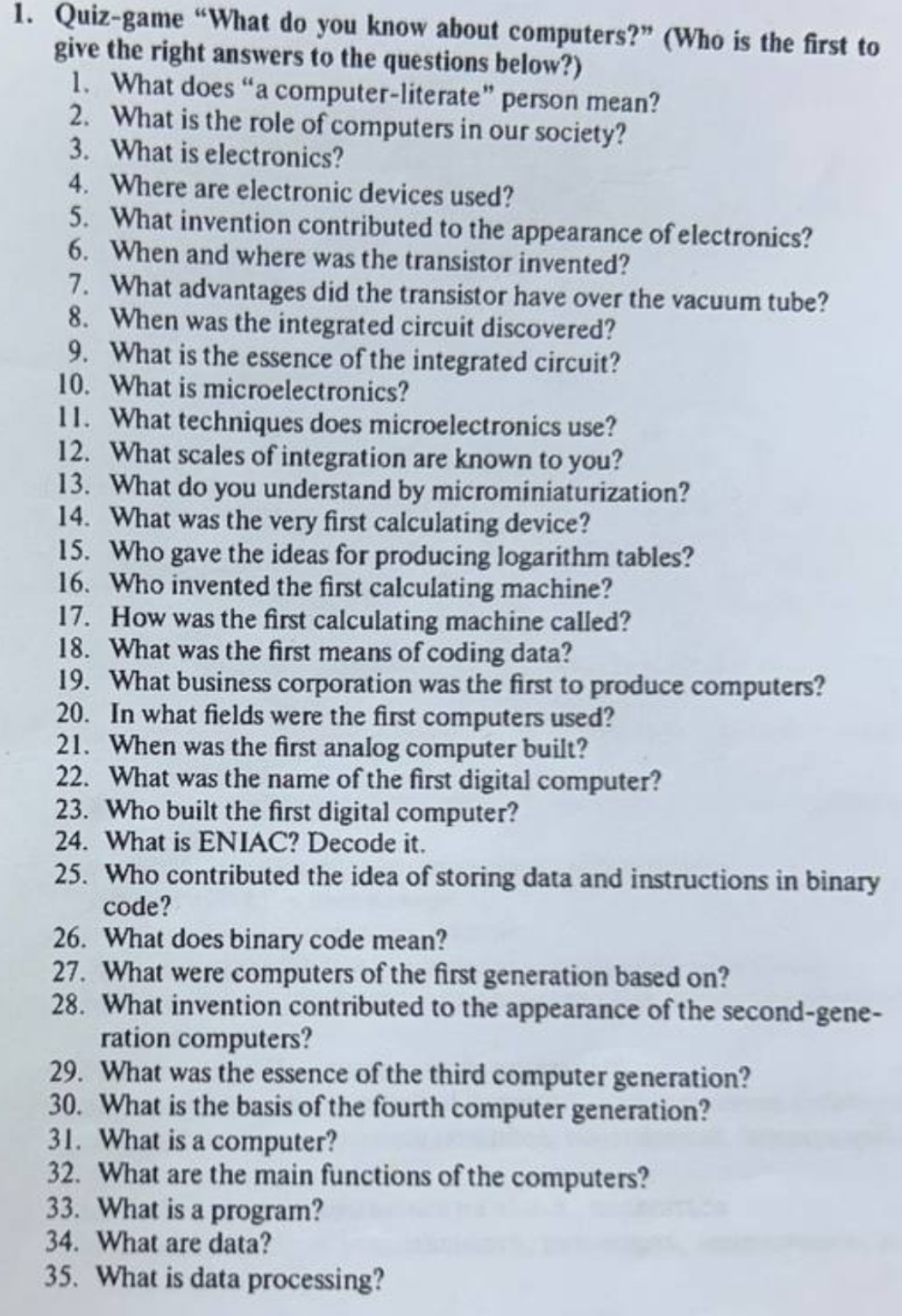
Реши задачу: Ответьте на вопросы на фото на английском языке
lightbulbКраткий ответ
Готовые ответы на вопросы о компьютерной грамотности, роли компьютеров и электронике на английском языке. Удобно для переписывания в тетрадь.
Подробное решение
Хорошо, вот ответы на вопросы на английском языке, оформленные так, чтобы их было удобно переписать в тетрадь.
1. What does "a computer-literate" person mean?
A computer-literate person is someone who has the knowledge and skills to use computers and related technology efficiently.
2. What is the role of computers in our society?
Computers play a crucial role in modern society by facilitating communication, education, business, entertainment, scientific research, and many other aspects of daily life.
3. What is electronics?
Electronics is the branch of physics and technology concerned with the design of circuits, components, devices, and systems using electrons.
4. Where are electronic devices used?
Electronic devices are used almost everywhere: in homes (smartphones, TVs, computers), offices (laptops, printers), industries (robotics, control systems), medicine (diagnostic equipment), transportation (GPS, car electronics), and many other fields.
5. What invention contributed to the appearance of electronics?
The invention of the vacuum tube (or thermionic valve) significantly contributed to the appearance and development of electronics.
6. When and where was the transistor invented?
The transistor was invented in December 1947 at Bell Labs in Murray Hill, New Jersey, USA.
7. What advantages did the transistor have over the vacuum tube?
Transistors were much smaller, more reliable, consumed less power, generated less heat, and were more durable and cheaper to produce than vacuum tubes.
8. When was the integrated circuit discovered?
The integrated circuit was independently discovered by Jack Kilby in 1958 and Robert Noyce in 1959.
9. What is the essence of the integrated circuit?
The essence of the integrated circuit (IC) is to combine many electronic components (transistors, resistors, capacitors) onto a single, small semiconductor material (chip), allowing for complex circuits to be built in a compact and efficient way.
10. What is microelectronics?
Microelectronics is a subfield of electronics that deals with the design and manufacture of very small electronic components and circuits, typically on the micron or sub-micron scale.
11. What techniques does microelectronics use?
Microelectronics uses techniques such as photolithography, etching, doping, thin-film deposition, and packaging to create integrated circuits and other miniature electronic devices.
12. What scales of integration are known to you?
Common scales of integration include:
* SSI (Small-Scale Integration) - up to 10-100 transistors
* MSI (Medium-Scale Integration) - 100-1,000 transistors
* LSI (Large-Scale Integration) - 1,000-10,000 transistors
* VLSI (Very Large-Scale Integration) - 10,000 to millions of transistors
* ULSI (Ultra Large-Scale Integration) - millions to billions of transistors
13. What do you understand by microminiaturization?
Microminiaturization refers to the process of making electronic components and circuits smaller and smaller, allowing for more complex functionality in a reduced physical space.
14. What was the very first calculating device?
The abacus is often considered one of the very first calculating devices.
15. Who gave the ideas for producing logarithm tables?
John Napier is credited with inventing logarithms and providing the ideas for producing logarithm tables.
16. Who invented the first calculating machine?
Blaise Pascal invented the Pascaline, often considered the first mechanical calculating machine, in the 17th century.
17. How was the first calculating machine called?
The first calculating machine invented by Blaise Pascal was called the Pascaline.
18. What was the first means of coding data?
Early means of coding data included punched cards and punched paper tape.
19. What business corporation was the first to produce computers?
IBM (International Business Machines) was one of the first major business corporations to produce and market computers on a large scale.
20. In what fields were the first computers used?
The first computers were primarily used in scientific research, military applications (e.g., ballistics calculations, code-breaking), and government census operations.
21. When was the first analog computer built?
Early forms of analog computers existed in ancient times (e.g., Antikythera mechanism), but modern electrical analog computers began to emerge in the late 19th and early 20th centuries.
22. What was the name of the first digital computer?
One of the earliest programmable electronic digital computers was the Atanasoff-Berry Computer (ABC), though ENIAC is often cited as the first general-purpose electronic digital computer.
23. Who built the first digital computer?
John Atanasoff and Clifford Berry built the Atanasoff-Berry Computer (ABC). J. Presper Eckert and John Mauchly built ENIAC.
24. What is ENIAC? Decode it.
ENIAC stands for Electronic Numerical Integrator and Computer. It was one of the first electronic general-purpose digital computers.
25. Who contributed the idea of storing data and instructions in binary code?
John von Neumann is widely credited with formalizing the concept of the stored-program computer architecture, where both data and instructions are stored in the same memory using binary code.
26. What does binary code mean?
Binary code is a system of representing text, computer processor instructions, or other data using only two symbols, typically 0 and 1.
27. What were computers of the first generation based on?
First-generation computers were based on vacuum tubes.
28. What invention contributed to the appearance of the second-generation computers?
The invention of the transistor contributed to the appearance of second-generation computers.
29. What was the essence of the third computer generation?
The essence of the third computer generation was the use of integrated circuits (ICs), which allowed for smaller, faster, more reliable, and more affordable computers.
30. What is the basis of the fourth computer generation?
The basis of the fourth computer generation is the use of Very Large-Scale Integration (VLSI) microprocessors, which allowed for entire central processing units (CPUs) to be placed on a single chip.
31. What is a computer?
A computer is an electronic device that can store, retrieve, and process data, and execute a sequence of instructions (a program) to perform various tasks.
32. What are the main functions of the computers?
The main functions of computers include input (receiving data), processing (manipulating data), output (displaying results), and storage (saving data).
33. What is a program?
A program is a set of instructions written in a specific programming language that tells a computer what to do.
34. What are data?
Data are raw facts, figures, or symbols that represent information, which can be processed by a computer.
35. What is data processing?
Data processing is the manipulation of data by a computer to transform it into meaningful information.