
Task 1.
Karen Hewitt wrote the book "Understanding Britain" where she gives some useful hints for Russians. What do you think her hints are about? (anticipating/applying background knowledge)
a) how to behave when you are a guest at a British home
b) how to give gifts
c) how different British people act in this or that situation
d) what you can treat British guests to
e) how to behave at table
f) how to answer personal questions
g) how to behave if you don't know what to do next
h) how to enjoy yourself in Britain
My thoughts on Karen Hewitt's hints:
I believe Karen Hewitt's hints are very helpful for Russians who plan to visit the UK or interact with British people. They help to understand cultural peculiarities and avoid awkward situations. Here are my thoughts on each point:
a) How to behave when you are a guest at a British home: This is a crucial aspect. Knowing the rules of etiquette when visiting will help you feel more confident and make a good impression. For example, it's important to know when to arrive, what to bring, and how to behave at the table.
b) How to give gifts: The culture of gift-giving can vary significantly. In Russia, it's common to give gifts for many occasions, and they can often be quite generous. In Britain, there might be specific nuances, such as what is considered appropriate or not, and when it's best to give gifts.
c) How different British people act in this or that situation: Understanding how British people react in different circumstances will help to correctly interpret their behavior and avoid misunderstandings. This can apply to both formal and informal situations.
d) What you can treat British guests to: If you are hosting British guests, it's important to know what dishes or drinks they might enjoy, and what might be unfamiliar or even undesirable. This shows respect for their culture.
e) How to behave at table: Table etiquette is a universal yet culturally specific thing. Knowing British table manners (e.g., how to use cutlery, when to start eating, how to converse) is very important.
f) How to answer personal questions: Different cultures have different boundaries for personal space and the appropriateness of personal questions. British people might be more reserved, and it's important to know how to tactfully answer or deflect overly personal questions.
g) How to behave if you don't know what to do next: This is perhaps one of the most valuable hints. Not knowing the rules can cause stress. Knowing how to politely ask or how to act in an uncertain situation will be very helpful.
h) How to enjoy yourself in Britain: Ultimately, all these hints are aimed at making your stay in Britain pleasant and comfortable. Understanding the culture helps you relax and get more enjoyment from interactions and new experiences.
Task 2.
What did the author write about in fact? Match Karen Hewitt's hints with the paragraphs. (matching/reading for the main idea)
A. All countries have unwritten but important rules of behaviour, which can only be explained by the people who live in that country. But they can act differently in one and the same situation: "When Englishmen are introduced to each other, they shake hands and say 'How do you do?'."
Do they? Sometimes they do. But life is not that ceremonious. So I can give you only general advice. No rules. We remember that foreigners don't know our ways, and as long as you are friendly and polite from the heart we don't mind that you behave a bit strangely.
The information about behaviour rules is usually true for many, but not for all British people do this or that." Better to say: "Some British people ..."
And we are sometimes not sure how to act and can't tell you how to act in this or that situation. You may find out that, in answer to questions, we often answer, "Well, it depends."
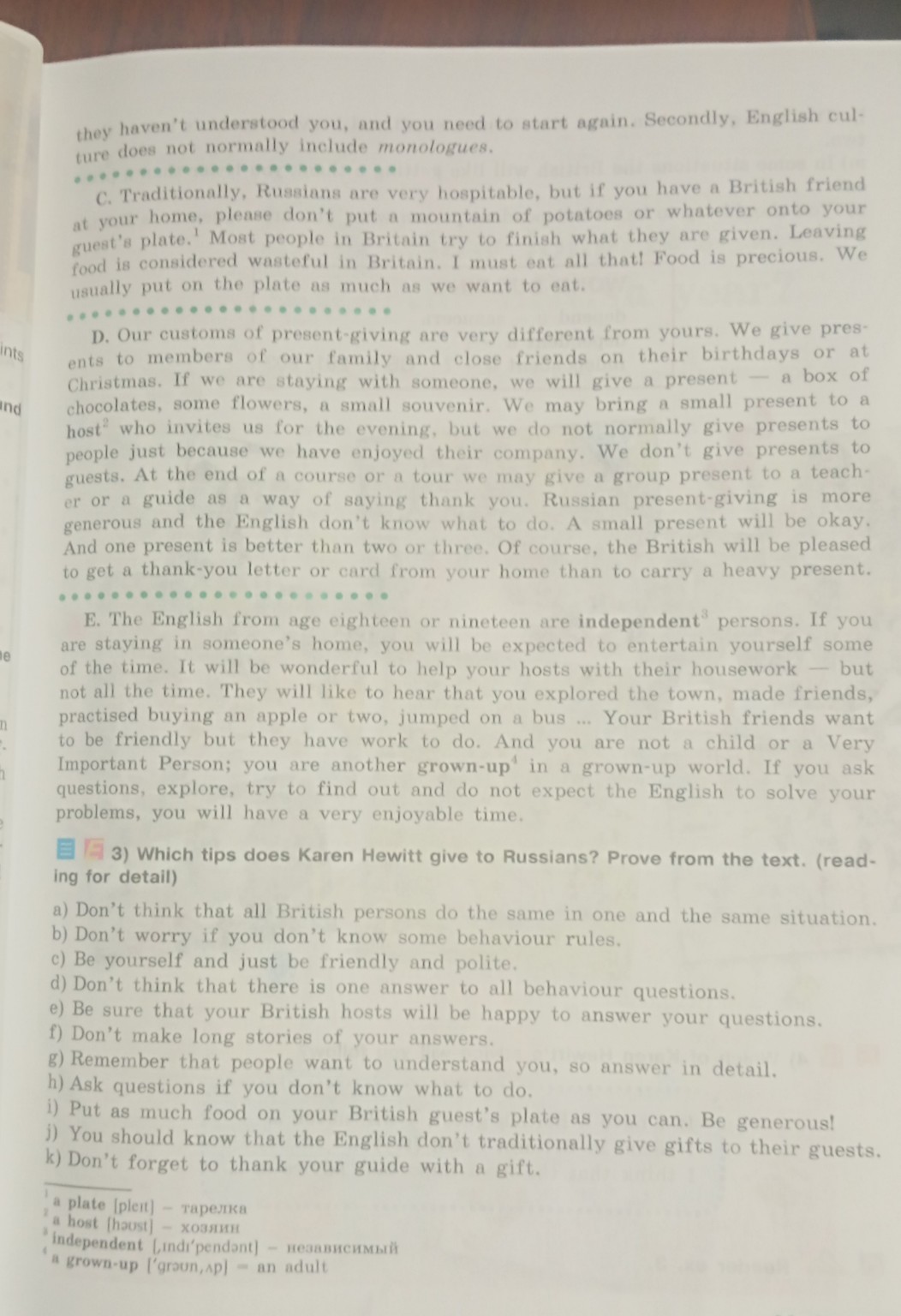
B. If you are a guest at a British home, my advice is: "Ask, if you don't know what to do next." People enjoy explaining. And if you are asked questions, try to explain in answer. People enjoy trying to understand. But don't feel that an easy question needs a ten-minute answer. Stop before you have finished your story, so that your friends can ask further questions. First, you may find that
C. Traditionally, Russians are very hospitable, but if you have a British friend at your home, please don't put a mountain of potatoes or whatever onto your guest's plate. Most people in Britain try to finish what they are given. Leaving food is considered wasteful in Britain. I must eat all that! Food is precious. We usually put on the plate as much as we want to eat.
D. Our customs of present-giving are very different from yours. We give presents to members of our family and close friends on their birthdays or at Christmas. If we are staying with someone, we will give a present — a box of chocolates, some flowers, a small souvenir. We may bring a small present to a host who invites us for the evening, but we do not normally give presents to people just because we have enjoyed their company. We don't give presents to guests. At the end of a course or a tour we may give a group present to a teacher or a guide as a way of saying thank you. Russian present-giving is more generous and the English don't know what to do. A small present will be okay. And one present is better than two or three. Of course, the British will be pleased to get a thank-you letter or card from your home than to carry a heavy present.
E. The English from age eighteen or nineteen are independent persons. If you are staying in someone's home, you will be expected to entertain yourself some of the time. It will be wonderful to help your hosts with their housework — but not all the time. They will like to hear that you explored the town, made friends, practised buying an apple or two, jumped on a bus ... Your British friends want to be friendly, but they have work to do. And you are not a child or a Very Important Person; you are another grown-up in a grown-up world. If you ask questions, explore, try to find out and do not expect the English to solve your problems, you will have a very enjoyable time.
Matching Karen Hewitt's hints with the paragraphs:
a) how to behave when you are a guest at a British home — This relates to paragraphs B, C, and E. Paragraph B gives general advice on what to do if you don't know, as a guest. Paragraph C addresses table behavior and attitudes towards food. Paragraph E discusses how to behave as an adult guest in a British home.
b) how to give gifts — This relates to paragraph D, which details British gift-giving customs.
c) how different British people act in this or that situation — This relates to paragraph A, which explains that rules of behavior are not always universal and can depend on the situation, and that not all British people act the same way.
d) what you can treat British guests to — While not directly stated, paragraph C indirectly touches on this by mentioning that British people dislike food waste and prefer moderate portions. This might imply not to overload their plates.
e) how to behave at table — This relates to paragraph C, which states that British people try to finish what they are given and dislike food waste.
f) how to answer personal questions — While there isn't a direct paragraph, paragraph B, which advises not to give overly long answers and to let friends ask questions, might indirectly touch on this, implying not to delve too deeply into personal details unless asked.
g) how to behave if you don't know what to do next — This relates to paragraph B, which directly advises: "Ask, if you don't know what to do next."
h) how to enjoy yourself in Britain — This relates to paragraph E, which gives advice on being an independent guest, exploring, and helping hosts to have "a very enjoyable time."
Task 3.
Which tips does Karen Hewitt give to Russians? Prove from the text. (reading for detail)
a) Don't think that all British persons do the same in one and the same situation.
b) Don't worry if you don't know some behaviour rules.
c) Be yourself and just be friendly and polite.
d) Don't think that there is one answer to all behaviour questions.
e) Be sure that your British hosts will be happy to answer your questions.
f) Don't make long stories of your answers.
g) Remember that people want to understand you, so answer in detail.
h) Ask questions if you don't know what to do.
i) Put as much food on your British guest's plate as you can. Be generous!
j) You should know that the English don't traditionally give gifts to their guests.
k) Don't forget to thank your guide with a gift.
Karen Hewitt's tips to Russians and proof from the text:
a) Don't think that all British persons do the same in one and the same situation.
Proof: "The information about behaviour rules is usually true for many, but not for all British people do this or that." (Paragraph A)
b) Don't worry if you don't know some behaviour rules.
Proof: "We remember that foreigners don't know our ways, and as long as you are friendly and polite from the heart we don't mind that you behave a bit strangely." (Paragraph A)
c) Be yourself and just be friendly and polite.
Proof: "as long as you are friendly and polite from the heart we don't mind that you behave a bit strangely." (Paragraph A)
d) Don't think that there is one answer to all behaviour questions.
Proof: "And we are sometimes not sure how to act and can't tell you how to act in this or that situation. You may find out that, in answer to questions, we often answer, "Well, it depends."" (Paragraph A)
e) Be sure that your British hosts will be happy to answer your questions.
Proof: "People enjoy explaining." (Paragraph B)
f) Don't make long stories of your answers.
Proof: "But don't feel that an easy question needs a ten-minute answer. Stop before you have finished your story, so that your friends can ask further questions." (Paragraph B)
g) Remember that people want to understand you, so answer in detail.
Proof: "And if you are asked questions, try to explain in answer. People enjoy trying to understand." (Paragraph B)
h) Ask questions if you don't know what to do.
Proof: "If you are a guest at a British home, my advice is: "Ask, if you don't know what to do next."" (Paragraph B)
i) Put as much food on your British guest's plate as you can. Be generous!
Proof: This statement contradicts the text. The text says: "Most people in Britain try to finish what they are given. Leaving food is considered wasteful in Britain. I must eat all that! Food is precious. We usually put on the plate as much as we want to eat." (Paragraph C). This means you should not put too much food, as British people try to finish everything they are served and dislike waste.
j) You should know that the English don't traditionally give gifts to their guests.
Proof: "We don't normally give presents to people just because we have enjoyed their company. We don't give presents to guests at the end of a course or a tour..." (Paragraph D)
k) Don't forget to thank your guide with a gift.
Proof: "we may give a group present to a teacher or a guide as a way of saying thank you." (Paragraph D)