
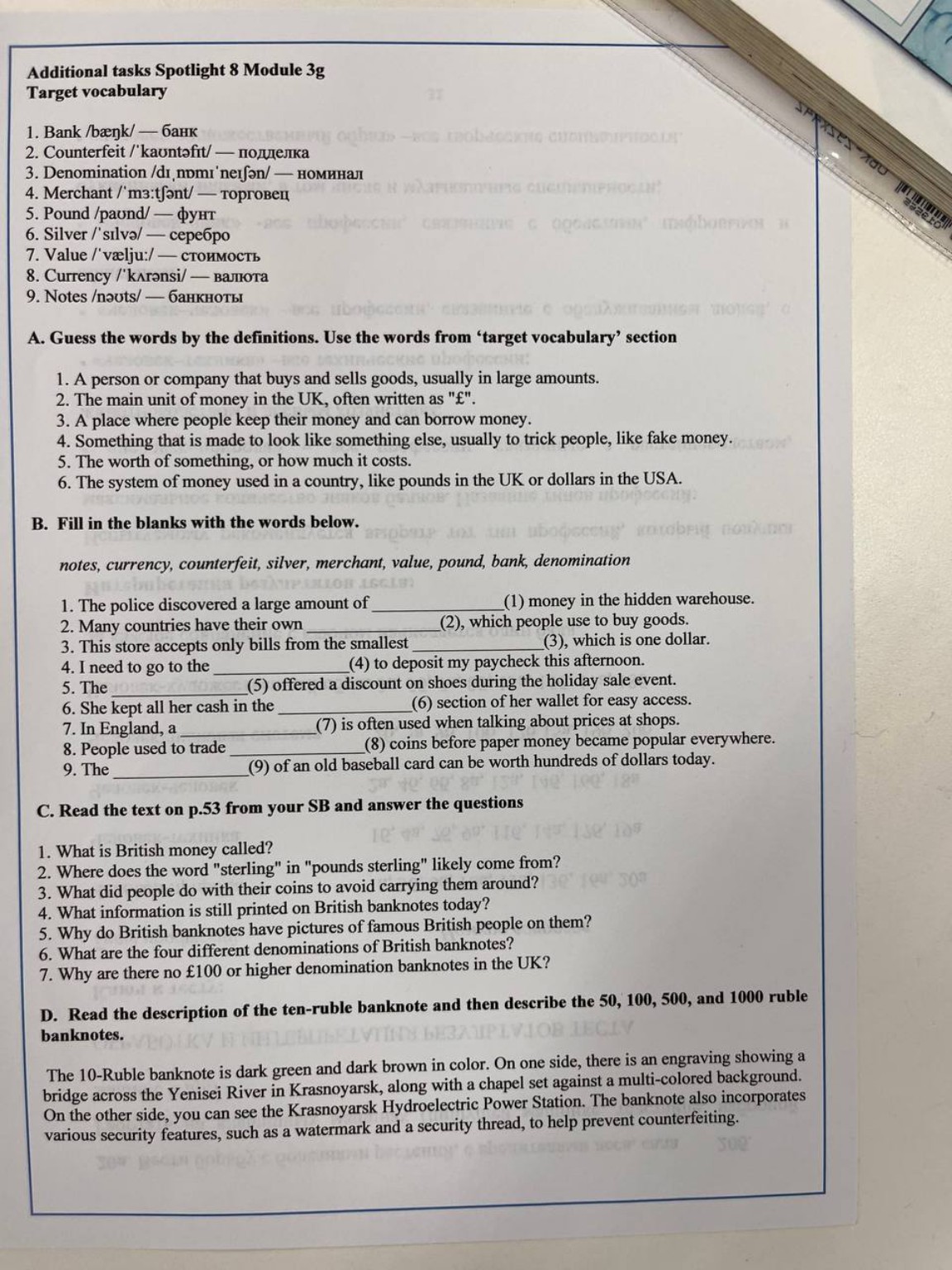
A. Угадайте слова по определениям. Используйте слова из раздела "Целевая лексика".
1. A person or company that buys and sells goods, usually in large amounts.Ответ: Merchant (Торговец) 2. The main unit of money in the UK, often written as "£".
Ответ: Pound (Фунт) 3. A place where people keep their money and can borrow money.
Ответ: Bank (Банк) 4. Something that is made to look like something else, usually to trick people, like fake money.
Ответ: Counterfeit (Подделка) 5. The worth of something, or how much it costs.
Ответ: Value (Стоимость) 6. The system of money used in a country, like pounds in the UK or dollars in the USA.
Ответ: Currency (Валюта)
B. Заполните пропуски словами.
Слова для использования: notes, currency, counterfeit, silver, merchant, value, pound, bank, denomination. 1. The police discovered a large amount of **counterfeit** money in the hidden warehouse. 2. Many countries have their own **currency**, which people use to buy goods. 3. This store accepts only bills from the smallest **denomination**, which is one dollar. 4. I need to go to the **bank** to deposit my paycheck this afternoon. 5. The **merchant** offered a discount on shoes during the holiday sale event. 6. She kept all her cash in the **pound** section of her wallet for easy access. 7. In England, a **silver** is often used when talking about prices at shops. 8. People used to trade **notes** (coins) before paper money became popular everywhere. 9. The **value** of an old baseball card can be worth hundreds of dollars today.C. Прочитайте текст на странице 53 из вашего учебника и ответьте на вопросы.
(Так как текст на странице 53 не предоставлен, я дам общие ответы, основанные на общеизвестной информации о британских деньгах.) 1. What is British money called?Ответ: British money is called **Pound Sterling** (Фунт Стерлингов). 2. Where does the word "sterling" in "pounds sterling" likely come from?
Ответ: The word "sterling" likely comes from the Old English word "steorling" (little star), referring to a small silver coin, or from the word "Easterlings", referring to merchants from Eastern Germany who traded with England using reliable silver coins. 3. What did people do with their coins to avoid carrying them around?
Ответ: Historically, people would deposit their coins with goldsmiths or early banks, who would issue receipts or "banknotes" in return. These banknotes could then be used for transactions, reducing the need to carry heavy coins. 4. What information is still printed on British banknotes today?
Ответ: British banknotes today typically feature: * Portrait of the reigning monarch (currently King Charles III). * Portrait of a famous historical British figure on the reverse side. * The value of the banknote (denomination). * The signature of the Chief Cashier of the Bank of England. * Security features (holograms, watermarks, security threads). * Architectural images or other symbols representing British culture. 5. Why do British banknotes have pictures of famous British people on them?
Ответ: British banknotes feature famous British people to celebrate their contributions to British society, culture, science, and history. It serves as a way to honor national heroes and educate the public about important figures. 6. What are the four different denominations of British banknotes?
Ответ: The four different denominations of British banknotes currently in circulation are: **£5, £10, £20, and £50**. 7. Why are there no £100 or higher denomination banknotes in the UK?
Ответ: The Bank of England has not issued £100 or higher denomination banknotes for general public use for several reasons: * Lower denominations are sufficient for most everyday transactions. * Larger denominations could facilitate illegal activities like money laundering and tax evasion, as they are easier to transport and conceal. * The UK banking system is highly developed, with widespread use of electronic payments, making large cash transactions less necessary.